Block print textiles explained for fashion and home fabrics

a[data-rs-seo-link]{text-decoration:underline!important;color:#1a56db!important;cursor:pointer!important;}a[data-rs-seo-link]{text-decoration:underline!important;color:#1a56db!important;cursor:pointer!important;}
What block print textiles are
Block print textiles are fabrics decorated by pressing a carved block onto cloth with dye, pigment, mordant, or resist paste. The technique can produce crisp repeats, layered florals, geometric borders, and irregular all-over patterns. It is not the same as a machine-perfect print. Small shifts in pressure, alignment, fabric texture, and dye absorption are part of the look. For fashion and home products, the value of block printing lies in this balance: a repeatable design made through a process that still shows human judgment.
The term is broad. It can refer to traditional Indian hand block printing, contemporary studio fabrics, heritage-inspired interiors, scarves, dresses, quilts, table linens, and accessories. It does not by itself mean natural dye, organic cotton, or fully handmade production from start to finish. Those claims need to be checked separately. For related fabric explainers, visit Materials and Textiles.
How the block printing process works
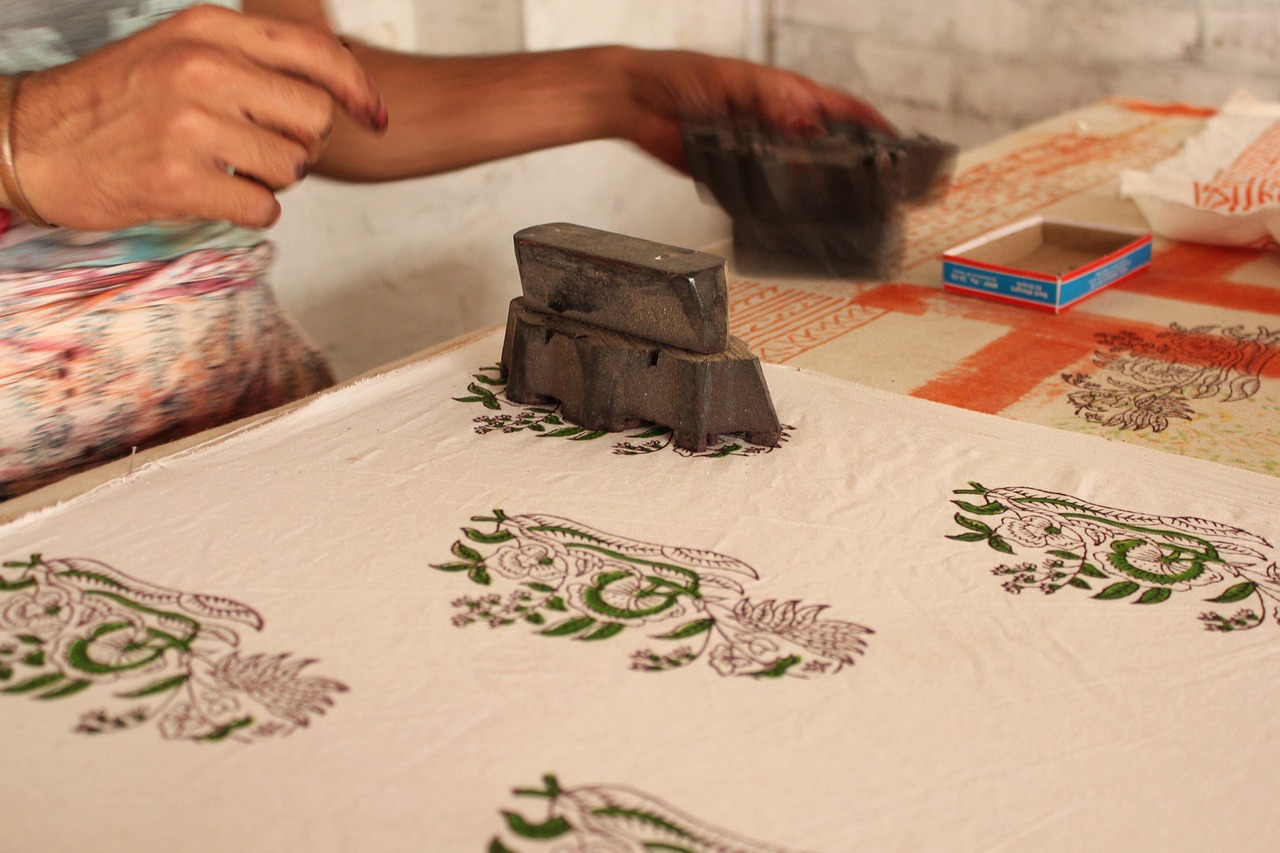
The basic method is straightforward, but consistent results require skill. A design is first translated into one or more blocks, traditionally carved from wood. Raised areas of the block carry the printing medium, while carved-away areas remain unprinted. The printer loads the block, places it on the fabric, applies pressure, and repeats the action across the cloth.
In a single-color print, one block may be enough. More complex designs often need several blocks: one for an outline, others for filled areas, borders, or secondary colors. Each block must register with the previous impression. Even a small positioning error can change the rhythm of the pattern, so repeat planning matters as much as carving.
Common production stages
- Fabric preparation: Cloth is often washed, scoured, or treated so it can receive the printing medium more evenly.
- Block carving: The pattern is cut into wood, leaving raised areas that will transfer the design.
- Printing: The artisan stamps the block onto the fabric, repeating the motif by eye and hand-guided registration.
- Drying and fixing: Depending on the dye or pigment system, the print may need drying, steaming, washing, curing, or other finishing.
- Inspection: Finished cloth is checked for smudging, excessive misregistration, weak impressions, and color consistency.
Direct, resist, and mordant printing
Block print textiles are not made with one universal recipe. Public craft documentation from India’s Office of the Development Commissioner for Handicrafts describes hand block printing as a traditional textile art using carved wooden blocks, while museum and craft sources show that different regions and workshops use different print chemistry.
Direct printing applies color where the block touches the cloth. This approach is common in many decorative fabrics and can be used with pigment binders or dye systems, depending on the workshop and the fiber.
Resist printing applies a paste that blocks dye from reaching selected areas. After dyeing and washing, the resisted parts remain lighter or take color differently. Dabu-style work in parts of India is often discussed in this context, though local recipes and methods vary by workshop.
Mordant printing uses a substance that helps certain dyes bond to the textile in printed areas. Historically, mordant and dye knowledge was central to many cotton printing traditions. For buyers, the key point is that the visible print may depend not only on the block but also on fabric preparation, dye class, water quality, washing, and finishing.
Historical and regional context
Block printing on textiles has a long history across Asia and developed into especially rich traditions in India. Government craft sources in India list many regional forms, including Sanganeri, Bagru, Ajrakh, Bagh, Dabu, and other named traditions. These names are not only style labels. They can refer to place, process, motif vocabulary, dye practice, and community knowledge.
Rajasthan is frequently associated with hand block printing. State craft material describes Sanganer near Jaipur as known for fine hand block printing, while Bagru is often associated with earthier palettes, resist work, and traditional dye processes. These descriptions are useful, but buyers should avoid treating them as fixed rules. Regional craft practices evolve, and contemporary workshops may combine heritage techniques with market-driven colors, new fabrics, or modified finishing methods.
Museum sources such as the Victoria and Albert Museum also place Indian textiles within a wider global history of trade, design exchange, and fashion influence. Printed cottons moved across markets, inspired European textile printing, and shaped taste in dress and interiors. That context matters because many motifs seen today are not isolated decorative choices; they are part of a long conversation between craft, commerce, and design adaptation.
Why hand-printed fabric looks different from screen or digital print
Identifying block print textiles is less about looking for imperfection and more about reading how the pattern was built. A block-printed repeat often has small variations at the edge of each stamp. Pressure may be stronger in one corner. A filled area may look slightly grainy where the fabric texture resisted full contact. Adjacent colors may overlap or leave narrow gaps.
These details can be attractive when they are controlled. They become quality issues when the print is unintentionally blurred, heavily distorted, unevenly fixed, or inconsistent across a garment panel where symmetry is expected.
| Method | Typical strength | Common limitation |
|---|---|---|
| Hand block printing | Craft character, tactile repeat, flexible small-batch production | Slower output and natural variation between impressions |
| Screen printing | Clean color areas and efficient repeat production | Setup can be less practical for very small runs or many colorways |
| Digital textile printing | High detail, photographic effects, quick artwork changes | May lack the relief, pressure marks, and craft variation of hand printing |
For designers, the choice depends on the product. A relaxed cotton dress, quilted jacket, cushion cover, or tablecloth may benefit from the visible rhythm of hand printing. A tailored garment requiring exact motif placement may need more sampling, tighter cutting control, or a different printing method. See also: Apparel Products.
Materials, dyes, and care considerations
Cotton is closely associated with block printing because it can be absorbent, stable, and comfortable for apparel and home textiles. Voile, cambric, poplin, canvas, and heavier cottons all behave differently. A fine cotton may show delicate linework, while a heavier weave can soften detail. Linen, silk, and blends can also be printed, but they may require different preparation and finishing.
Dye claims deserve careful reading. Traditional descriptions often emphasize vegetable dyes, mineral-derived colors, or natural dye processes. At the same time, official craft descriptions for Rajasthan note that synthetic dyes have replaced vegetable dyes in many cases because they are easier to use and more widely available. This is not automatically negative, but it changes how buyers should evaluate color, wash performance, wastewater responsibility, and labeling accuracy.
Care should be based on the actual fabric and print system, not just the word block print. As a cautious general approach, wash printed cottons in cold water with mild detergent, avoid prolonged soaking, dry away from harsh direct sun, and test dark or saturated colors before mixing them with pale laundry. For commercial products, colorfastness should be verified through supplier documentation or recognized testing rather than assumed from appearance.
How to evaluate block print textiles before buying or specifying them
A useful assessment looks at design, process, and performance together. A beautiful motif is not enough if the cloth bleeds heavily, shrinks unexpectedly, or has weak printing in high-visibility areas. Likewise, perfectly even printing may not be the goal if the product is meant to celebrate handmade character.
- Check repeat logic: Look at how motifs meet at repeat joins, borders, seams, and garment panels.
- Read the edge quality: Clean but slightly varied edges usually signal controlled hand work; muddy edges may indicate overloading or poor contact.
- Ask about dye and fixing: Natural, synthetic, pigment, resist, and mordant systems have different performance profiles.
- Review fabric behavior: Consider shrinkage, drape, transparency, abrasion, and intended end use.
- Separate craft from sustainability claims: Hand printing is labor-intensive, but responsible production also involves water use, chemical handling, wages, and traceability.
- Request samples: A swatch shows scale, handle, color, and variation more reliably than a product photo.
For fashion products, block print textiles often work best when pattern scale and garment shape are planned together. A large border may be striking on a skirt hem but awkward on a small blouse panel. A dense all-over floral can hide seam breaks, while a geometric repeat may require more careful cutting. For home textiles, consider viewing distance: cushions and table linens can carry smaller motifs, while curtains and quilts may need bolder repeats to read clearly in a room.
Frequently asked questions
Are all block print textiles handmade?
Not always. The term usually refers to a block-based printing method, but production can vary. Some fabrics are fully hand-stamped, while others may use block-inspired motifs produced by screen or digital printing. Product descriptions should state the method clearly.
Do small print irregularities mean poor quality?
Minor variation is normal in hand block printing and can be part of its appeal. Quality problems are more serious: heavy smudging, unstable color, major unintended distortion, weak fixing, or pattern placement that disrupts the finished product.
Are natural dyes better than synthetic dyes?
Neither category is automatically better in every situation. Natural dyes can offer distinctive depth and cultural value, but they still require skilled mordanting, water management, and careful care. Synthetic dyes can provide consistency and performance, but responsible handling and wastewater controls remain important.
What fabrics are most common for block printing?
Cotton is especially common because it is versatile, absorbent, and suitable for many apparel and home uses. Linen, silk, and blends may also be used, but each fiber changes the sharpness, color uptake, drape, and care needs of the final textile.
How should designers use block prints in modern collections?
Start with the end product. Match motif scale to pattern pieces, order enough sampling to understand variation, and decide which irregularities are acceptable before production. The strongest results usually treat block printing as both a design constraint and a creative feature, not as surface decoration added at the last minute.